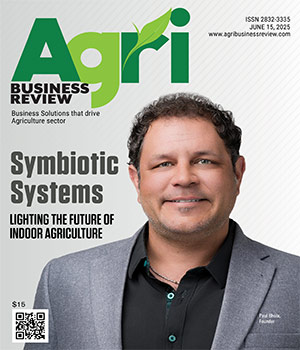
 Paul Bhola, Founder
 Indoor farming has long promised a revolutionary approach to agriculture, offering controlled environments for growing crops regardless of weather or climate. However, the industry has been hindered by outdated lighting systems that rely on broad-spectrum illumination, attempting to replicate natural sunlight rather than optimizing for plant biology. Traditional high-pressure sodium (HPS) and full-spectrum LED systems waste energy by emitting wavelengths that plants either don’t use efficiently or actively filter out. These systems fail to account for the fact that plants don’t require uniform light exposure, but instead respond to specific wavelengths at different growth stages.
Symbiotic Systems, founded by Paul Bhola, is pioneering an adaptive lighting technology that uses narrowband LED systems to specifically stimulate plant responses. With patented dynamic lighting and AI-driven controls, Symbiotic Systems enhances yield, reduces operational costs, and improves crop quality by stimulating the plants to produce outcomes using the plant's own growth systems.

“Plants don’t just need light. They need the right signals at the right time. What we are doing is providing them with a language they understand,” says Bhola.
This approach ensures that plants receive the exact wavelengths required for optimal growth and compound production. Independent studies have validated this technology, demonstrating up to a fivefold increase in medicinal compound yields.
From Discovery to Revolutionary Technology
Symbiotic Systems' journey began in 2008–2009 when Bhola was developing infrastructure for large-scale resorts in Latin America. Faced with the challenge of providing consistent food and water supplies to remote locations, he explored indoor agriculture. However, he found traditional methods inefficient, largely due to lighting systems designed to replicate sunlight rather than cater to plants' natural adaptability.
Through extensive research, Bhola discovered that plants respond not to broad spectrums of light, but to specific wavelengths that influence biological processes like photosynthesis, growth, and compound production. This insight led to the development of Symbiotic Systems’ narrowband LED technology, which emits targeted wavelengths to activate plant chromophores—molecules that capture light for energy production. By fine-tuning these wavelengths, the system enhances metabolic pathways, optimizing growth, nutrient absorption, and the production of valuable compounds.
“Instead of trying to recreate sunlight, we’re mimicking what plants naturally respond to—specific wavelengths that promote growth and productivity,” says Kenneth Happel, CTO.
Unlike conventional broad-spectrum lighting, which wastes energy on unnecessary wavelengths, Symbiotic Systems' precise approach improves efficiency while lowering energy costs.
-
Plants don’t just need light. They need the right signals at the right time. What we are doing is providing them with a language they understand
AI-Driven Smart Lighting for Maximum Efficiency
To complement its innovative lighting system, Symbiotic Systems employs real-time AI-driven controllers that continuously monitor plant responses and dynamically adjust lighting conditions. Unlike large, cumbersome AI models, the company processes small, real-time datasets to provide immediate micro-adjustments, ensuring optimal growth conditions at all times.
This efficiency makes the technology highly scalable, cost-effective, and easy to integrate into existing agricultural frameworks. The system delivers:
1. Optimized energy use by eliminating unnecessary light wavelengths.
2. Consistently high-quality yields across various plant types.
3. Customizable light spectra for different growth stages.
4. Seamless scalability from small greenhouses to industrial-scale facilities.
Transforming Agriculture through Lighting Innovation
A key part of Symbiotic Systems' growth strategy is its patented process and technology combined with a market empowering licensing model, designed to accelerate market adoption. Inspired by the Dolby® model in the audio industry, the company is licensing its technology to OEM component manufacturers, allowing light manufacturers to build their own specialized products using these components integrating this adaptive lighting system into existing agricultural infrastructure.
By offering components rather than full systems, the company enables flexible adoption across multiple industries, including commercial indoor farming, medicinal agriculture, and high-value horticulture. A recent study demonstrated a fivefold increase in beta-caryophyllene, a valuable medicinal compound, using Symbiotic’s adaptive lighting—highlighting the transformative potential of this technology.
With global expansion on the horizon, the company anticipates commercial availability within the next 9 to 18 months, with widespread adoption expected as manufacturers and growers recognize the efficiency, scalability, and superior performance of adaptive lighting technology.
By optimizing energy use, enhancing yields, and ensuring consistent quality, Symbiotic Systems is setting a new benchmark for sustainable indoor farming. The future of farming isn’t just about growing more—it’s about growing smarter.
Guiding Plant Growth Through Adaptive Light Intelligence
Controlled-environment agriculture is forcing greenhouse operators, vertical farming investors and plant-science companies to rethink what lighting systems are expected to accomplish. Electricity savings alone no longer justify major infrastructure investment. Buyers now evaluate whether lighting can improve crop uniformity, accelerate flowering cycles, increase biomass yield and influence nutrient or medicinal compound production without driving up facility costs or adding unnecessary system complexity.
A large portion of the horticultural lighting market still approaches cultivation through broad-spectrum replication models intended to imitate sunlight. Plant science research has steadily challenged that assumption. Crops respond to precise spectral cues that influence developmental behavior, stress adaptation and metabolic activity inside the plant itself. That distinction matters commercially. In fruit-bearing horticulture and pharmaceutical cultivation, even modest increases in compound concentration or production consistency can alter margin performance across an entire facility.
More advanced cultivation systems are shifting toward adaptive spectral management rather than fixed lighting formulas. Plant requirements change during vegetative growth, flowering periods and environmental stress conditions. Static-spectrum systems often struggle to respond to those shifts, resulting in uneven harvest quality or inconsistent growth rates between production cycles. Buyers evaluating plant-growth platforms should examine whether spectral composition, light intensity and timing can be adjusted according to crop-specific developmental patterns instead of relying on rigid preset configurations.
The relationship between lighting and environmental coordination has also become a meaningful point of separation between vendors. Lighting hardware operating independently from irrigation controls, nutrient delivery and climate systems limits how precisely growers can manage cultivation conditions. Larger indoor facilities increasingly depend on synchronized environmental controls where lighting interacts continuously with fertilizer schedules, water usage and growth monitoring data. Systems that require oversized computing infrastructure or complicated integration layers can create new cost burdens that offset production gains, particularly in facilities operating at scale.
Scientific validation carries greater weight in this segment than broad automation claims. Controlled-environment agriculture has attracted a wave of technology providers over the past decade, though many still lack measurable biological data or defensible intellectual property tied directly to plant behavior. Growth systems intended to influence flowering triggers, biomass accumulation or secondary metabolite production require repeatable performance data grounded in plant physiology rather than generalized software positioning. Patent portfolios, spectral-response methodologies and documented metabolic-response outcomes now serve as stronger indicators of long-term commercial credibility.
Within this market, Symbiotic Systems has developed a plant-growth platform centered on adaptive narrow-band spectral control intended to influence metabolic expression rather than simply illuminate crops. Its technology adjusts spectral output according to developmental behavior across both food-production and medicinal cultivation environments. The company’s work involving photomorphogenesis and spectral-response control reflects a biologically focused cultivation model that differs from conventional horticultural lighting systems built around static spectrum delivery. Its broader platform strategy also incorporates AI-directed environmental coordination capable of managing lighting behavior, nutrient inputs and cultivation conditions inside controlled facilities. For buyers evaluating plant-growth technologies where crop quality, medicinal compound concentration and production economics directly affect facility performance, Symbiotic Systems offers a technically differentiated approach moving toward wider commercial deployment.
...Read more